


Budget 2026 Explainer
Below is a detailed explainer about the biggest changes to the property market and how it will affect investors now and into the future.
We have used working examples for each of the main points.

Negative Gearing: The "Quarantining" Rule
The most significant change is the removal of the ability to offset investment losses against your salary for established properties.
The Deadline: Any property purchased after 7:30 pm (AEST) on 12 May 2026 is subject to the new rules. Properties under contract before this time are "grandfathered" and retain existing tax benefits indefinitely.
The "New Build" Exemption: Properties that increase housing supply (new builds, off-the-plan, or additional units in a subdivision) remain fully deductible against your salary.
How Quarantining Works: If you buy an established property and it runs at a loss:
You cannot use that loss to reduce the tax on your wages.
The loss is quarantined (stored) in a virtual "bucket."
This loss can only be used to offset future rental profits or to reduce the Capital Gains Tax (CGT) when you eventually sell the property.
Working Example: The Cash-Flow Gap (Negative Gearing)
To understand the impact of the new "Quarantining" rule, we compare a New Build (which retains full tax benefits) against an Established Property purchased after the 12 May 2026 deadline.
The Scenario
Investor Salary: $150,000 (Marginal Tax Rate: 39% including Medicare Levy).
Property Purchase Price: $1,000,000.
Annual Rental Income: $40,000 ($770/week).
Annual Interest Expense: $52,000 (6.5% interest-only loan on $800k).
Operating Expenses: $9,700 (Rates, insurance, repairs, and management fees).
The Calculation: Annual Holding Costs
Item | Amount |
Gross Rental Income | $40,000 |
Total Expenses ($52,000 + $9,700) | ($61,700) |
Net Annual Rental Loss | ($21,700) |
The Comparison: New Build vs. Established
Feature | New Build (Exempt) | Established (Quarantined) |
Tax Treatment | Loss is deducted from your $150k salary. | Loss is quarantined in a "bucket". |
New Taxable Income | $150,000 - $21,700 = $128,300 | $150,000 (No change) |
Annual Tax Refund | $8,463 (39% of the $21,700 loss) | $0 |
Weekly Out-of-Pocket | $254.55 | $417.30 |
What this means for the Investor:
Immediate Cash Flow: The owner of the Established Property is $8,463 worse off per year in take-home pay. They must cover the full $417 weekly gap between the rent and the mortgage from their own pocket without a tax offset to assist.
The "Carry Forward" Benefit: While the Established Property owner misses out on the refund today, their $21,700 loss is not lost. It is stored. If they hold the property for 10 years, they will have a $217,000 "tax credit" sitting in their quarantined bucket.
Future Application: That $217,000 can be used in future years to:
Wipe out tax on rental profits (should the property become positively geared).
Reduce the Capital Gains Tax (CGT) bill when the property is eventually sold.
Our Hot Take: Lending serviceability for established properties has become tighter. Because you no longer receive the annual tax refund, lenders will assess your ability to "carry" the full loss without Government assistance. This makes "New Builds" a far more attractive prospect for investors looking to maximise their borrowing capacity.

Capital Gains Tax: Discount vs. Indexation
The Budget replaces the traditional 50% CGT discount with a system that accounts for inflation, creating a tiered outcome for different property types.
Established Properties: The 50% discount is abolished for all properties purchased after 12 May 2026. You must use the Indexation Method, which calculates tax only on the "real" gain (profit minus the rate of inflation).
New Build "Choice" Advantage: Investors in new housing supply are granted a unique flexibility. Upon sale, you can choose whichever method results in a lower tax bill: the 50% Discount OR the Indexation Method.
The 30% Minimum Floor: A 30% minimum tax rate now applies to capital gains on established properties. This prevents high-wealth individuals from selling properties in "low-income" years to avoid paying a fair share of CGT. New Builds are exempt from this floor.
Working Example: The Sale Outcome (CGT Calculation)
This example demonstrates the critical "choice" available to New Build investors compared to the mandatory rules for Established property buyers under the new Budget measures.
The Scenario
Purchase Price: $1,000,000
Sale Price (after 10 years): $1,500,000
Estimated Inflation (CPI): 3% per annum
Investor’s Marginal Tax Rate: 39% (including Medicare Levy)
Method A: The 50% CGT Discount (Available for New Builds Only)
This is the "old" method. You ignore inflation and simply halve the profit before applying tax.
Gross Profit: $1,500,000 - $1,000,000 = $500,000
Apply 50% Discount: $500,000 ÷ 2 = $250,000
Tax Payable: $250,000 x 39% = $97,500
Method B: The Indexation Method (Mandatory for Established Properties)
This is the "new" method. You only pay tax on the "real" gain by adjusting the purchase price for inflation over the 10-year holding period.
Indexed Cost Base: $1,000,000 x (1.03)¹⁰ = $1,343,916
"Real" Capital Gain: $1,500,000 - $1,343,916 = $156,084
Subtract Quarantined Losses: (For Established Properties only). If you couldn't claim your annual losses against your salary, you subtract them here.
$156,084 - $217,000 (10 years of losses) = -$60,916
Taxable Amount: $0 (Losses wiped out the gain).
Tax Payable: $0
The Comparison: New Build vs. Established
Feature | New Build (Exempt) | Established (Post-Deadline) |
Available Method | Choice of Discount or Indexation. | Indexation only. |
Annual Tax Refunds | $84,630 (Received over 10 years). | $0. |
Tax Payable at Sale | $60,873 (Using Indexation). | $0 (Losses offset the gain). |
Total Wealth Position | +$306,757 | +$283,000 |
What this means for the Investor:
The "Choice" Advantage: For New Build investors, if inflation is high, they will choose Indexation to lower their tax. If inflation is very low, they can switch back to the 50% Discount. This flexibility is a massive strategic advantage.
The "30% Minimum Tax" Floor: For Established properties, a new "floor" has been introduced. Even if you sell in a year with $0 income (e.g., retirement), you must pay a minimum of 30% tax on your real gain. New Build investors are exempt from this 30% floor.
The Cash-Flow Trade-off: While the Established owner pays $0 tax at the end, they effectively "pre-paid" this by missing out on $84,630 in annual tax refunds over the decade.
Our Hot Take: The New Build path remains the superior wealth-creation strategy. By receiving annual refunds, you keep more capital in your offset account. The Established path results in a lower tax bill at the end, but significantly lower "net wealth" overall.
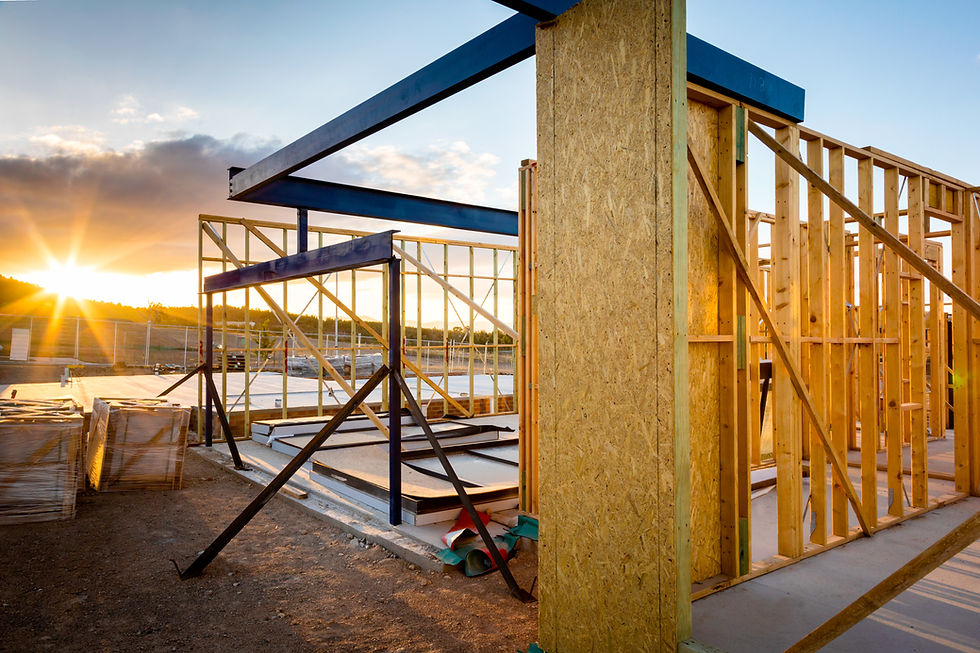
The "Net Increase" Supply Test
To qualify for "New Build" status, a project must result in a net increase in the number of dwellings on a single title.
Single Replacements: Knocking down one house and building one new house (a "knock-down rebuild") is treated as an established property because the dwelling count remains 1:1.
Subdivisions & Duplexes: If you knock down one house and build two or more units:
Unit 1 is considered the "replacement" and is treated as established.
Units 2, 3, and 4+ are considered "New Housing Supply" and receive full tax benefits.
Granny Flats: These are classified as "ancillary additions" and do not trigger a net increase in primary housing supply; therefore, they are subject to the established property rules.
Working Example: The "Net Increase" Test (Duplex Development)
This example illustrates how the Australian Taxation Office (ATO) apportioned tax benefits when an investor adds to the housing supply by replacing one dwelling with multiple units.
The Scenario
Project: Knocking down one established house and building a two-unit duplex.
Status: Both units are kept as long-term rentals on separate titles.
Funding: Two separate loans of $600,000 each.
Annual Loss: Each unit runs at a rental loss of $10,000 per annum.
The Classification
Under the 2026/27 Budget "Net Increase" rules, the tax treatment is split:
Unit | Classification | Reason |
Unit 1 | ❌ Established | This unit "replaces" the original dwelling. Since there is no net increase for this specific unit, it is treated as established. |
Unit 2 | ✅ New Build | This unit represents a net increase in supply (+1 dwelling). It qualifies for the "Gold Class" new-build incentives. |
The Impact on Your Annual Tax Return
Item | Unit 1 (Established) | Unit 2 (New Build) |
Annual Loss | ($10,000) | ($10,000) |
Salary Deduction | $0 (Losses are quarantined) | $10,000 (Fully deductible) |
Actual Tax Refund | $0 | $3,900 (at a 39% tax rate) |
Net Cash-flow Gap | $10,000 out-of-pocket | $6,100 out-of-pocket |
What this means for the Investor:
Strategic Apportionment: Even though both units are identical, the New Build unit (Unit 2) provides an immediate $3,900 cash injection every year. This helps to cross-subsidise the holding costs of the Established unit (Unit 1).
The Resale Strategy: If you decided to sell Unit 2 within 12 months of completion, you could market it to another investor as a "New Build," allowing them to inherit the salary-offsetting benefits. Unit 1 would likely be more attractive to an owner-occupier who isn't concerned with negative gearing.
Lending Considerations: When applying for finance, Chardon Home Loans would need to structure these as two distinct loans. We would work to ensure the "New Build" status is clearly identified to maximise your tax-effective borrowing capacity.
Our Hot Take: The "Net Increase" rule means that the more dwellings you add to a single site, the higher the percentage of your portfolio that qualifies for full tax benefits. For example, in a four-unit development (1 house replaced by 4), 75% of your losses would remain fully deductible against your salary.

The 12-Month "First Sale" Rule
The Budget has introduced a mechanism allowing the "New Build" status to be passed on to a subsequent buyer, significantly affecting resale value.
The Window: A property retains its status as a "New Build" if it is sold to its first purchaser within 12 months of the occupancy certificate being issued.
Investor Incentive: If you sell a newly built unit to another investor within this window, that investor "inherits" the right to negative gear against their salary.
The "Cliff": Once a property is older than 12 months (or has been previously sold/meaningfully occupied), it permanently reverts to "Established" status for all future owners.
Working Example: The 12-Month Resale Premium
This example demonstrates how the "New Build" status can be passed on to a subsequent buyer, and how this affects the valuation and marketability of your investment.
The Scenario
The Vendor (You): You have just completed a 4-unit development.
The Asset: Unit 3, which is classified as a "New Build" (+1 net increase).
The Timing: It is 6 months since the occupancy certificate was issued.
The Potential Buyers: 1. Investor A looking at your Unit 3 (6 months old).
Investor B looking at an identical unit across the street (14 months old).
The Comparison for the New Buyer
Feature | Your Unit 3 (New Build) | Competitor Unit (Established) |
Purchase Price | $1,000,000 | $1,000,000 |
Annual Rental Loss | ($21,700) | ($21,700) |
Salary Offset (Buyer) | ✅ Allowed | ❌ Banned (Quarantined) |
Annual Tax Refund | $8,463 | $0 |
CGT Treatment | Choice of 50% Disc or Index | Mandatory Indexation |
What this means for the Vendor (You):
The "Tax-Effective" Premium: Because your unit provides Investor A with an immediate $8,463 annual cash-flow advantage, your property is objectively more valuable than the established one. In a competitive market, you can justify a higher asking price because the "net cost" to the buyer is lower.
The 12-Month "Cliff": If you hold the property until month 13 before selling, the "New Build" status evaporates. The property would then be classified as Established for the next buyer, potentially reducing your pool of interested investors who rely on negative gearing for cash flow.
Marketing Strategy: When selling within the first year, your marketing material should highlight that the property is "New Build Tax Compliant". This alerts savvy investors that they can still access salary-offsetting benefits and the 50% CGT discount choice.
Critical Rules to Remember:
Meaningful Occupation: If you reside in the unit or lease it out for a significant period before selling, you must ensure the "first residential sale" status is not compromised. The ATO looks closely at whether the property has been "previously occupied" as a home.
The First Sale Rule: This transfer of "New Build" status only happens once. If Investor A buys it from you and then tries to sell it 2 months later, it becomes "Established" for the next person in line.
Our Hot Take: When we assist your potential buyers with finance, the "New Build" status is a significant factor in our serviceability calculations. A buyer who receives an $8,000 tax refund has a higher "disposable income" in the eyes of many lenders, often allowing them to borrow more to secure your property.
Disclaimer
Important Information: The content of this post is for general information and educational purposes only. It does not constitute formal financial, taxation, or legal advice. Every individual's situation is unique, and the details of the 2026 Federal Budget may affect you differently based on your specific circumstances.
Before making any financial decisions or organising changes to your mortgage or investment strategy, we recommend seeking professional advice tailored to your goals. For a personalised review of how these changes might impact your current home loan or borrowing favour, please contact the team at Chardon Home Loans directly. (Please note: Whilst all of the data collection and analysis was ours, we acknowledge that AI was used to make our ramblings and ideas coherent and understandable to a wider audience.)


Comments